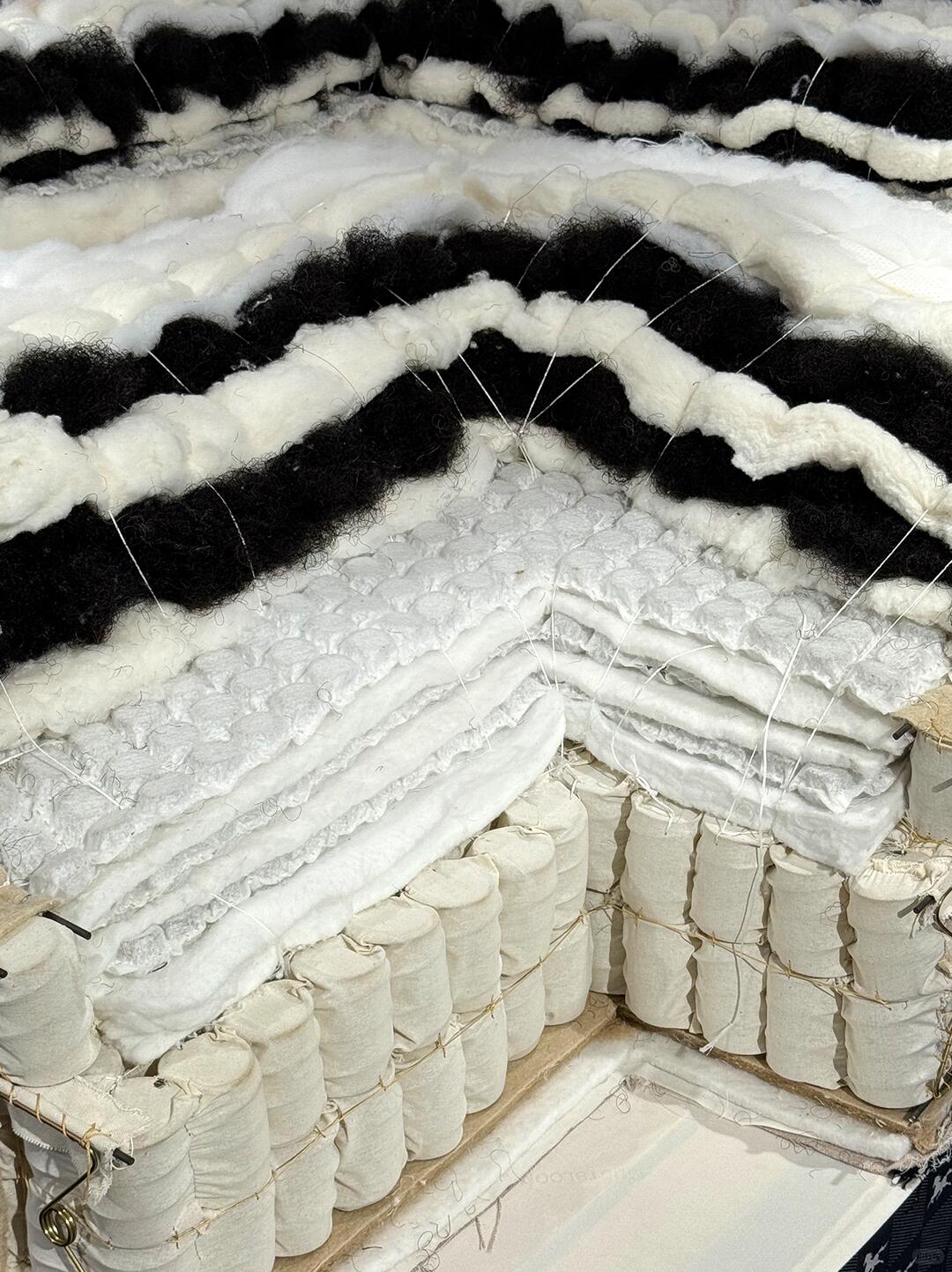
How hand tufting holds mattress layers together
A tuft is a fastening that brings several mattress layers together at one point. The small dimple in the surface can give you a clue, but the best way to understand the construction is to follow the thread through a cutaway. That tells you which layers the fastening reaches and whether the tufting belongs to the topper, the mattress, or both.
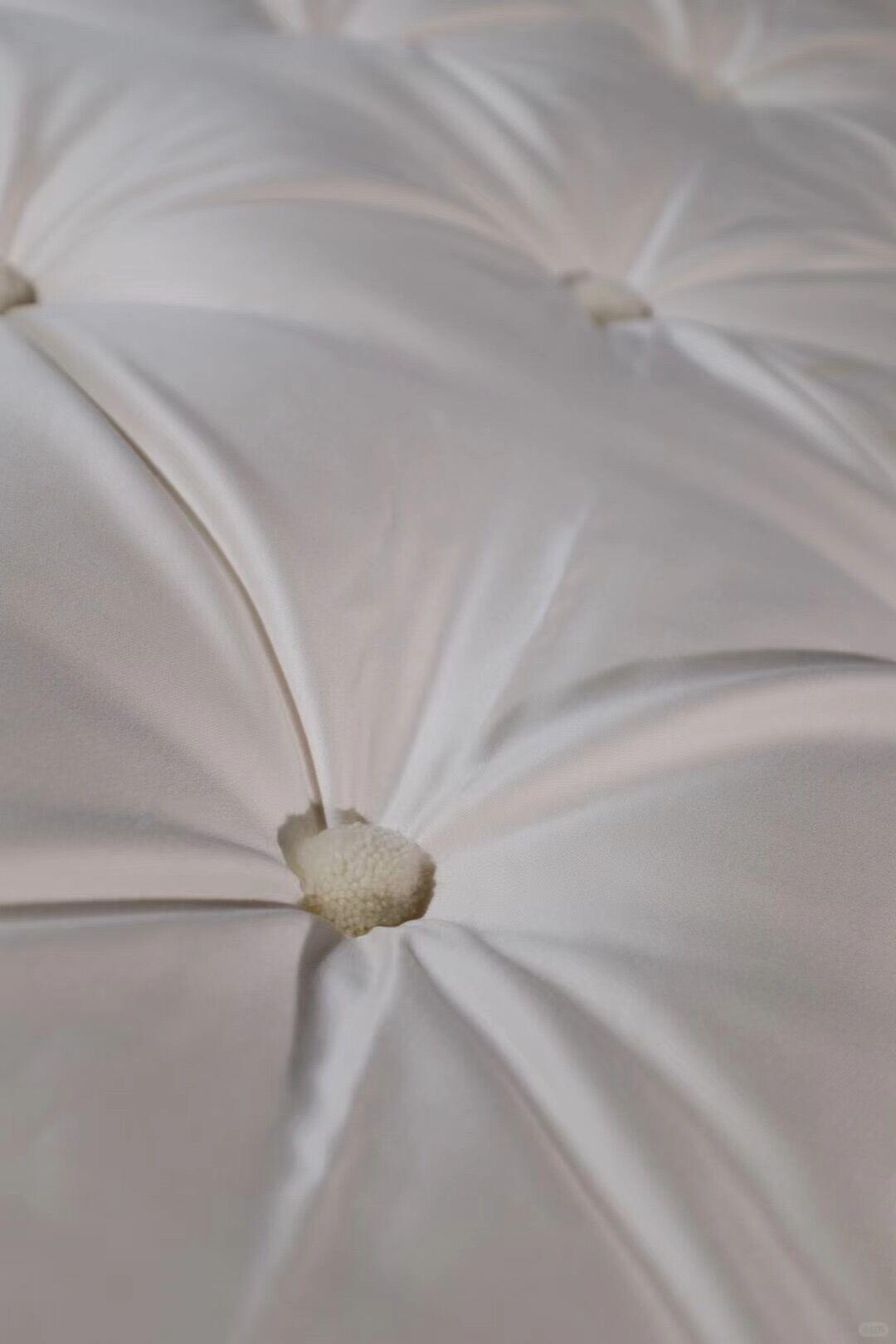
Follow a single tuft through the stack
In one common approach, a long needle carries a cord through the layers being secured. The cord is anchored and tensioned, drawing the padding together around the fastening. Repeating the operation across the surface creates a series of points that hold the selected layers in position. A close view may show a button, tie or gathered area of fabric, depending on how the cord is finished.
A U.S. patent from 1956 shows several ways of anchoring a tufting cord, including loops on the inside of the cover. The sectional drawings are useful because they show both the path of the cord and its anchoring points. The thread path on a particular contemporary mattress can differ, so use the drawings to understand the principle and a model-specific cutaway to understand what you are buying.
Distinguish a surface stitch from a through-tuft
Quilting can join the cover fabric to its backing or to a thin layer of padding. A through-tuft may reach farther into a group of fillings. From above, both techniques can create a repeated pattern or a small depression. From the side, the difference is the depth of the fastening and the layers it connects.
If a product photograph shows a deep-looking dimple, ask which materials the thread passes through. A useful answer names the layers and identifies both ends of the fastening. If only a cover photograph is available, ask for a cross-section or a sample of the exact model.
Check the topper and mattress separately
With a two-piece set, the topper and mattress have their own covers and filling stacks. Ask the maker to identify the areas that are tufted in each component and how the remaining pieces are assembled. For example, in a showroom, ask to see the underside of the topper and the top of the mattress separately, and check how the two pieces sit together when assembled.
Luna and Vantis both pair a 12 cm topper with a 30 cm mattress. Their layer lists place horsehair and wool-and-cotton padding in both components, but their cover fabrics and some fillings differ. Luna has a cotton-check cover and lists Australian cashmere in its mattress. Vantis has a chenille cover and lists mulberry silk in its topper. The two specifications make useful examples when learning to distinguish a filling list from an assembly description.
What glue-free filling fixation covers
DerOath secures its filling layers by hand tufting, without bonding those filling layers with glue. To evaluate that statement, focus on what holds the stack together. Thread or cord drawn through a stack holds it mechanically at the fastening points. In a bonded layer, the bond between the materials performs that job.
If adhesive use across the complete bed matters to you, ask separately about the cover assembly, preformed pads, spring unit and edge construction. These are distinct components. It is useful to get the answer for each component in writing so you can compare the scope of one maker's description with another's.
Read the tuft pattern and inspect the finish
At a sample bed, start by looking across the surface in good light. Check whether the pattern looks consistent across comparable areas and whether the fabric around the fastening lies as you would expect. Next, put your usual type of sheet or protector over the surface if the showroom allows it. A detail that stands out to your hand on bare fabric may feel different through your bedding.
A tuft count only makes sense in context. Ask what area was counted and which size or component it describes. If you are comparing different sizes or different components, two totals may refer to different surface areas. A description of the thread path and layer stack gives you more direct information about what the fastening does.
Use a cutaway and a trial together
Ask the seller to show the cover, the first few fillings, the fastening, and the support unit below. Follow the thread through the diagram and ask how the other layers or components are connected. If the image is a general construction sample, request a layer list for the exact model before relying on it.
When you lie down, give yourself time to notice the surface texture and how far you settle in your normal sleeping position. Roll to the other side and sit at the edge if you use the edge for getting into bed. The cutaway explains how parts are secured. The trial tells you how the assembled bed feels through the bedding you are likely to use.