Why horsehair is used in mattresses
Curled horsehair is used in mattress upholstery because a single layer can do several jobs. It can yield under weight and regain loft as the load lifts. The gaps between the curls give air and water vapour a route through the filling, while the hair itself takes up and releases some moisture as humidity changes. How much each property contributes depends on how the fibres are prepared, laid and held within the mattress.
What makes tail hair useful as a filling
Horse tail hair is a long natural fibre made largely of keratin, the structural protein found in hair and wool. Textile researchers studying horse tail and mane hair have measured fibre diameter, breaking strength, elongation and moisture absorption. Those measurements describe individual strands, which are the raw material from which an upholsterer builds a layer.
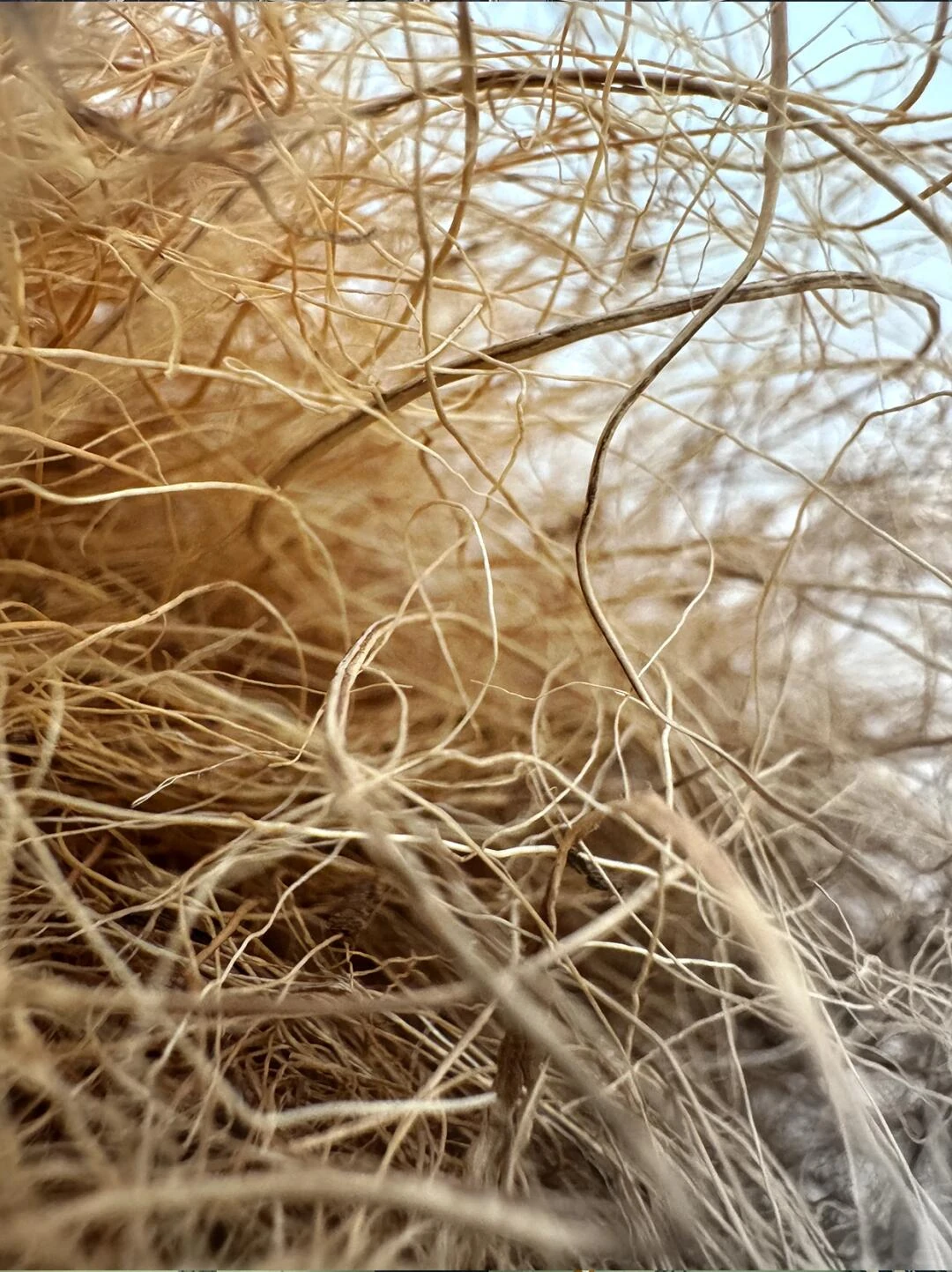
Length is especially useful in a loose filling. A long strand can curve through the depth of the layer and cross several neighbouring strands along the way. These crossings give the layer a three-dimensional structure with room for the strands to bend. The thickness that a filling develops under light or no load is called loft. In a mattress, that loft gives the layer a range of motion between its resting shape and its working thickness under load.
How curling gives the hair loft
Traditional upholstery preparation uses heat and moisture to set bends in the hair. In one method, the strands are held in twisted bundles and steamed, then opened out so that the individual fibres retain their curls. The UNIDO upholstery manual identifies curl as a source of resilience in prepared hair fillings.
Once the bundles are opened, the curls take up space in several directions. When they are spread over a mattress layer, sections of each strand stand away from neighbouring fibres between points of contact. The degree of curl, the care taken in separating the bundles and the way the hair is spread all help determine how much loft the finished layer can develop. This preparation turns a collection of strands into a pad with enough depth to yield under weight.
How the curls cushion and recover
Under load, the curved portions of the strands bend, nearby fibres shift against one another and the spaces between them narrow. As the layer gets thinner, more fibres can come into contact and share the load. That changing pattern of contact helps explain how a curled filling can yield at first and offer greater resistance as compression increases.
As weight shifts or lifts, the strands tend towards their earlier shapes and the layer regains some thickness. This return is what upholsterers mean by resilience. During a change in sleeping position, one area of the pad can begin to recover as another area begins to compress. The surface materials and the support beneath the pad also take part in that response, so the cushioning a person feels comes from the layers acting together.
How packing density shapes the feel
Packing density describes how much hair is held in a given volume. At the same finished thickness, a pad with more hair generally has more points of contact between the strands. A more loosely laid pad has more space for the fibres to move before they meet. These differences give the maker a way to tune how readily the upholstery yields under an initial load and how much resistance it develops as it compresses.
Density also varies across a pad if the hair is unevenly spread. A bunch of tightly packed curls can feel more resistant than an area with the same thickness and fewer strands. Opening the bundles thoroughly and laying the fibre to an even depth help give the cushioning a consistent response across the sleeping surface. The chosen density can then serve the intended feel of that layer within the whole mattress.
Where air moves through the layer
Air occupies the spaces between the curls. Some of those spaces connect across the thickness of the pad and along its plane, making the filling permeable to air. The shape and size of the pathways change under load. As someone settles onto the mattress, the local volume of those spaces decreases. As that area recovers, the spaces expand again, allowing air to move in response to the change in volume.
For air to travel through a complete mattress, it also needs a route through neighbouring layers or along the sides of the assembly. The weave of the outer cover, the structure of adjacent pads and the compression of the upholstery all affect that route. Horsehair contributes open space within the construction, and that space is most useful when it connects with the rest of the mattress.
How horsehair exchanges moisture
The air spaces between curls let water vapour reach the fibre surfaces. The hair itself is hygroscopic, meaning that it can take up water from humid air and release some of that stored moisture as the air around it becomes drier. Textile physicist I. C. Watt studied how horsehair and other keratin fibres respond to changes in relative humidity, measuring changes in the fibres alongside water uptake and release.
This gives the filling a capacity for temporary moisture buffering. As local humidity rises, some of the water vapour can enter the hair. As conditions change, moisture can return to the surrounding air and travel through the connected spaces in the pad. Vapour exchange occurs at the scale of the strand, while airflow occurs through gaps between strands. The two processes complement each other when the upholstery gives air access to the hair.
What horsehair contributes alongside other layers
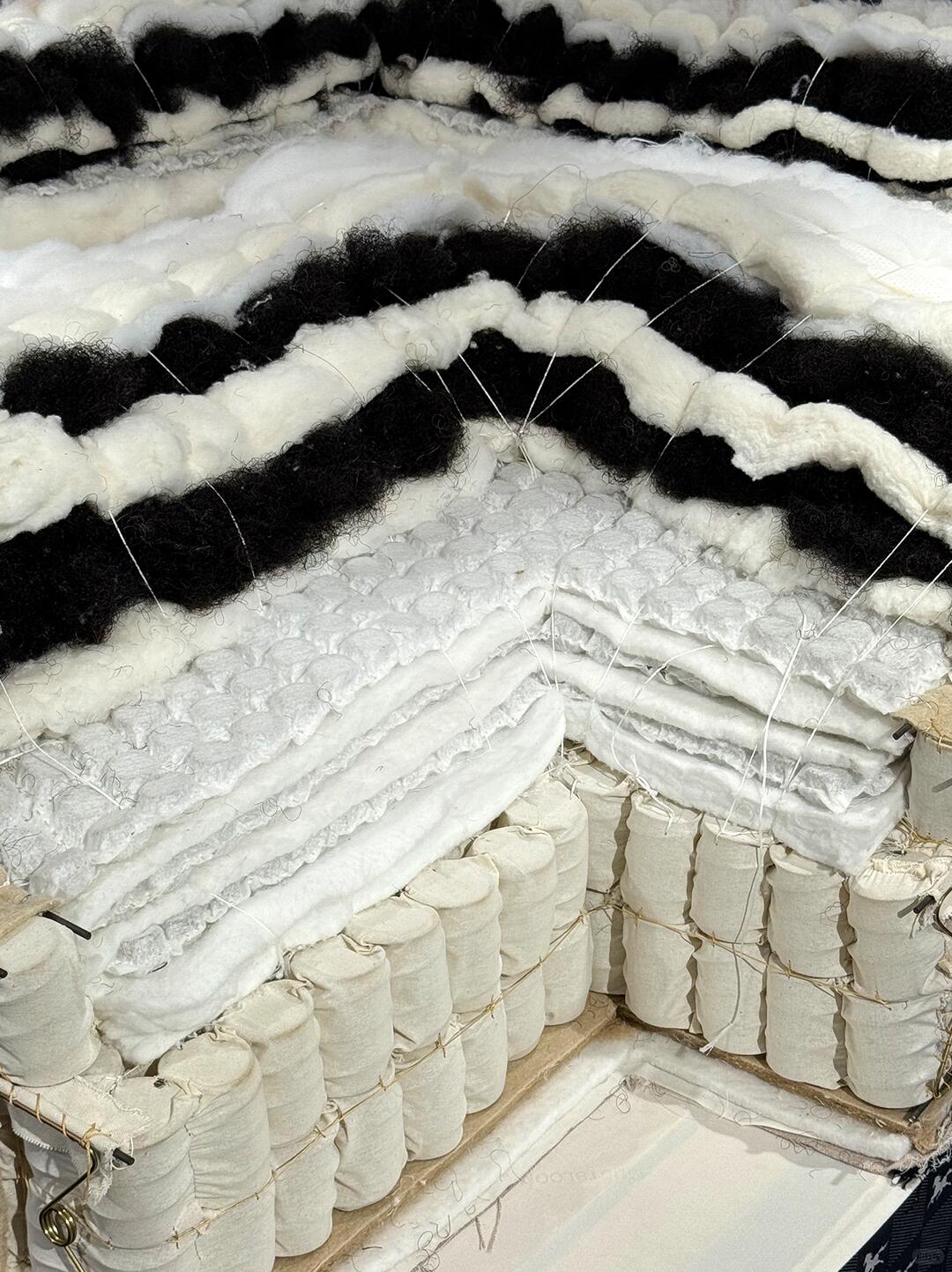
In a sprung mattress, the spring unit provides support at depth, while the upholstery above it shapes the first part of the mattress's response to weight. Softer surface layers can give the cover an initially gentle feel. Beneath them, curled horsehair can provide a cushion that continues to yield as weight settles and recovers as pressure eases.
Placement changes how distinctly that response is felt. A thick surface pad can spread an initial load over a wider area before it reaches the hair. A thinner pad can let the character of the horsehair come through earlier. A fabric separator beneath the filling can provide a continuous surface on which the hair rests. Each layer has a particular role, and its thickness and position influence how the horsehair contributes to the finished feel.
How upholstery work keeps the filling in place
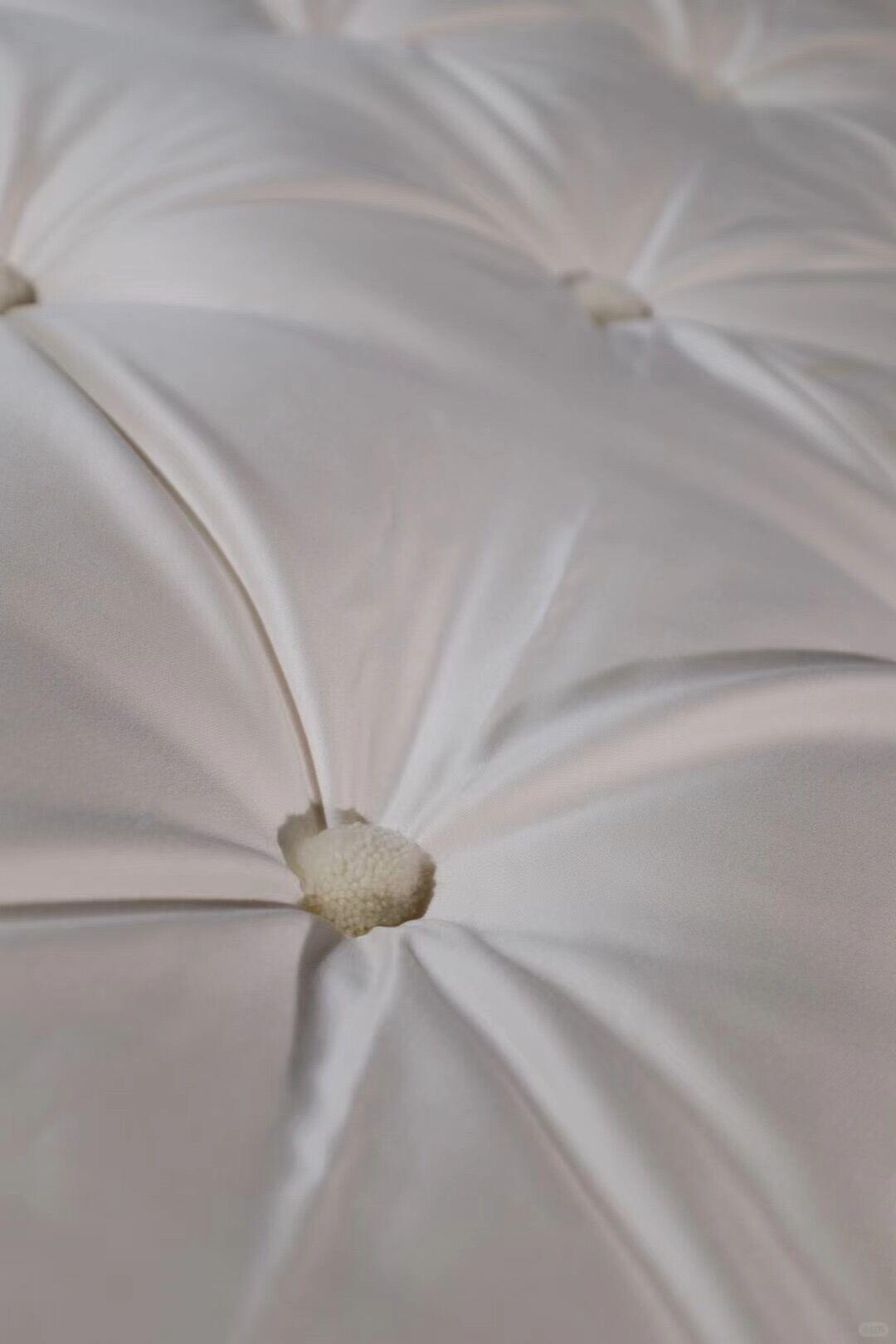
Making a consistent pad begins by opening the curls and spreading them so the layer reaches the intended depth across its full width. The maker then has to retain that distribution as the mattress is assembled and repeatedly loaded. Fabric enclosures can define the edges of the filling. In a tufted construction, stitches passing through the assembly draw the upholstery together at intervals and help limit movement between layers.
The restraint around the filling also influences how far the curls can flex. Tuft tension, the depth of the upholstery and the amount of hair laid into it determine how much space the strands have in the finished mattress. A maker can use those controls to hold the filling evenly while leaving it enough working depth to compress and recover.
Horsehair in historic mattress making
Conservators at Hampton Court Palace found horsehair among the fillings of linen mattress cushions on Queen Caroline's state bed. The bedding comprises six mattresses, with two structural mattresses below four silk-covered ones. Several of the cushions were quilted to keep their fillings evenly spread. The arrangement records a long-established way to build a bed surface by combining pads with different materials and roles.
Modern upholstery can apply the same principle within a single mattress. The maker can place an enclosed pad of curled hair at the depth where its response is most useful, then select a surface filling and a spring unit for their own roles. Holding those materials in separate layers gives the curled hair room to flex while letting the neighbouring layers shape how that movement feels at the surface.